

As we approach the end of 2024 I thought it would be interesting to rate Langley based on what has been accomplished this year in relation to Strong Towns’ five core campaigns - Safe and Productive Streets, and End Parking Mandates and Subsidies, Incremental Housing, Transparent Local Accounting, and Ending Highway Expansion.
These campaigns represent fundamental principles for building financially resilient and livable communities. Strong Towns, a movement focused on creating sustainable and prosperous cities, has identified these five areas as critical leverage points for transforming our municipalities from car-dependent, financially fragile places into thriving, walkable communities that can sustain themselves long-term. By examining Langley's progress in each of these areas, we can better understand where our community stands in its journey toward becoming a truly strong town, celebrate our successes, and identify areas where we need to focus more attention in the coming year.
Safe and Productive Streets
Langley Township
The current Langley Township council has raised the bar when it comes to safer streets, far more than any previous council has accomplished in this regard.
In January this year, the council voted to give staff a large budget of $480,000 for traffic calming project near schools.
Later, in July, the council voted to get a staff report on removing slip lanes along 88th Avenue, on 208th Street, Walnut Grove Drive and 212th Street. While I would like to think this in part due to our slip lanes campaign, it’s really part of an overall trend of this administration in taking the initiative to improve road safety and seriously tackle long standing issues.
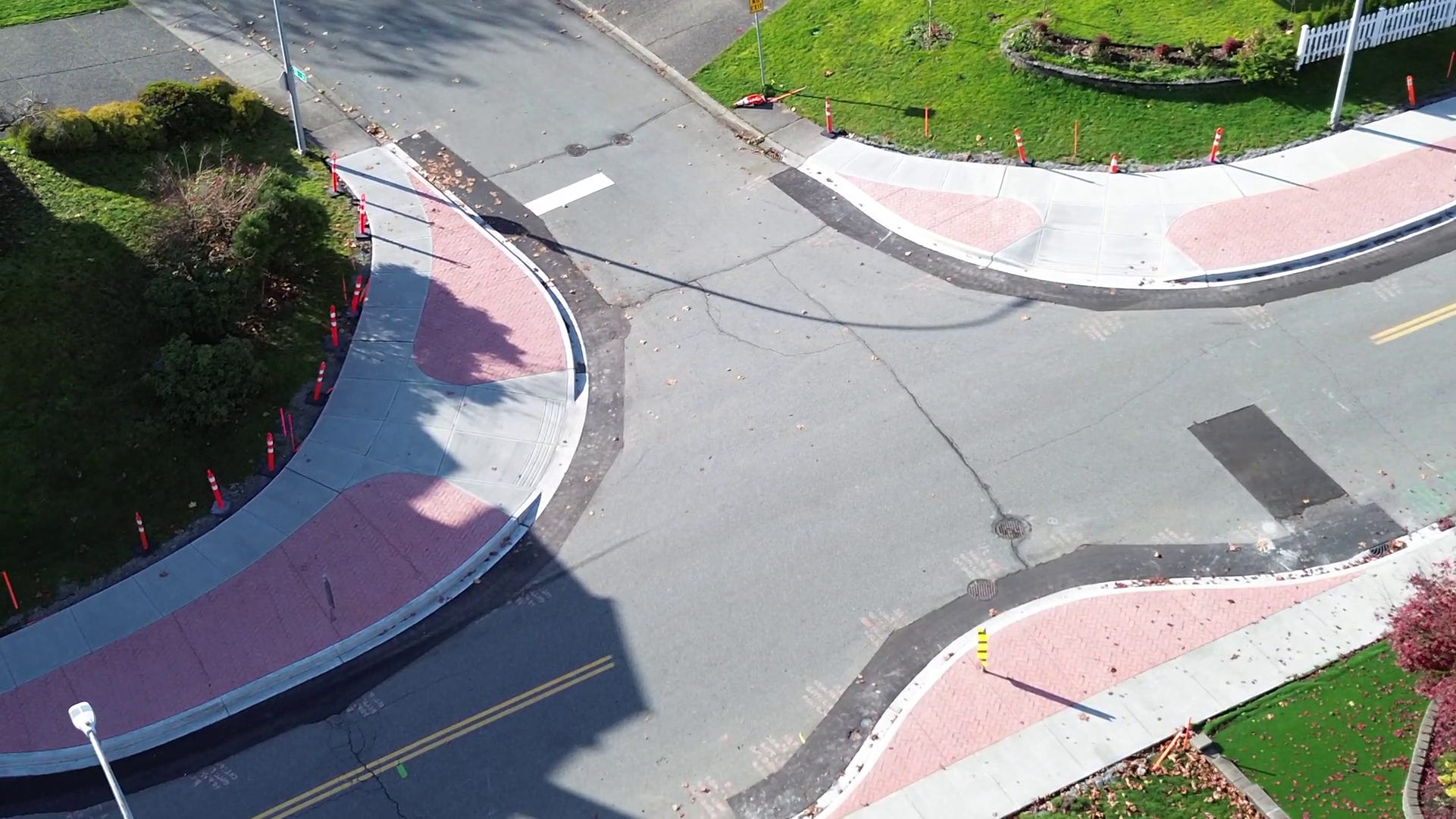
In April, a child was struck by a car on Telegraph Trail, and in response to this incident, the council approved another ambitious plan - concrete curb bump outs to slow down traffic along Telegraph Trail. Other cities have tried painted bump outs, but it is quite progressive and an amazing commitment to safety to go with concrete at so many intersections along the route.
And finally the council also approved a road diet project for 216th Street north of 88th Avenue up to 96th Avenue. The current stretch is essentially wide enough for 4 lanes, I believe to sort of “future proof” the area, but is configured 2 with parking. The problem is not only is this a lot of wasted space, the extra-wide travel lanes lead to people hurtling down the road in excess of 80kph to even 100kph. The proposed design scales things right down.
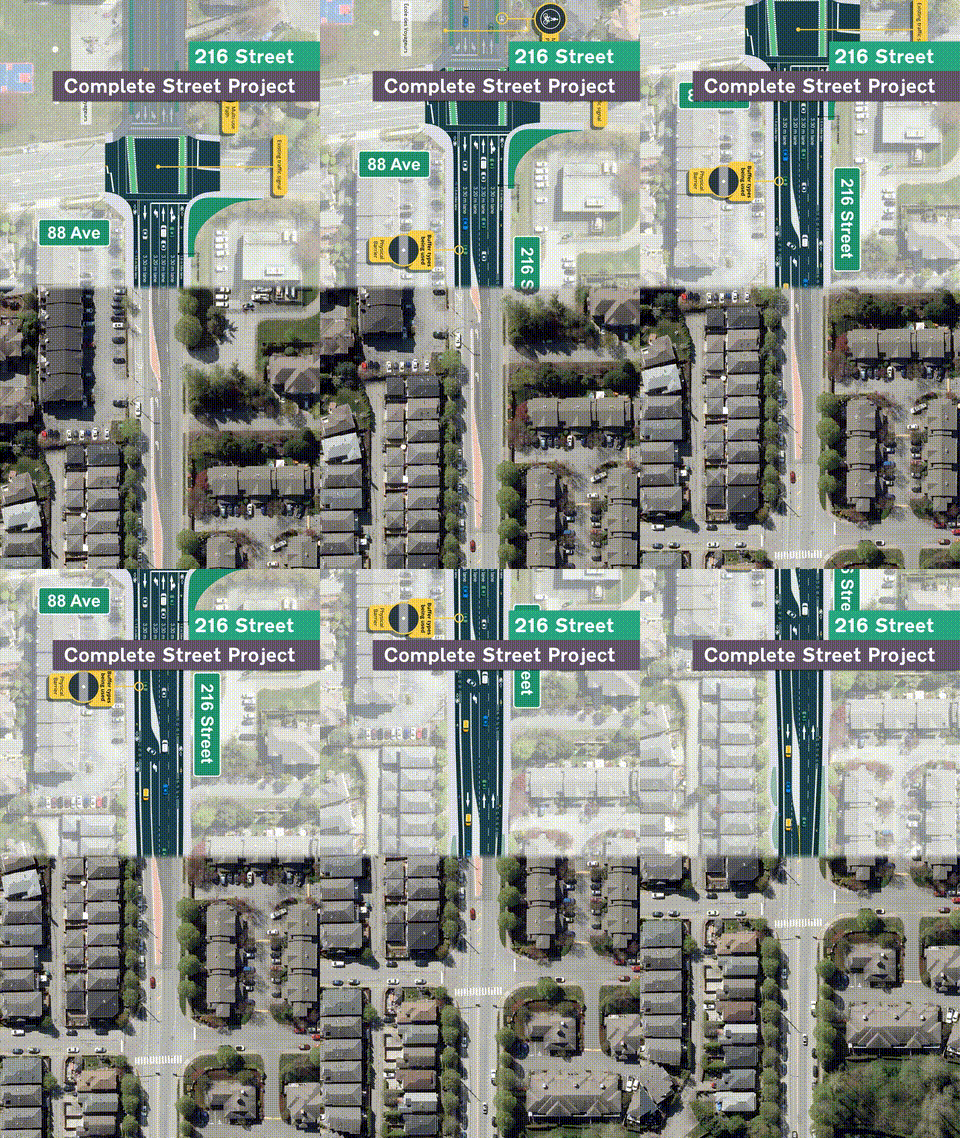
This project, like the curb bump-outs, is the first of it’s kind in the Township of Langley, and a really exciting multi-modal corridor. The only problem is really that it’s a one off, we will need more streets retrofitted like this, and a more expansive cycling network overall to see the benefits.
So in terms of the direction we’re moving in in these areas, I give Langley Township an A+ for Safe and Productive Streets.
Langley City
Langley City has also continued on it’s path to moving towards human scale streets. Turning right from 203rd Street onto 56th Avenue was originally a slip lane, and is now a rain garden. This was part of a wider renewal program for 56th Avenue overall. It seems likely that as more streets in Langley City are renewed, removing the slip lanes will continue to take place as part of that.
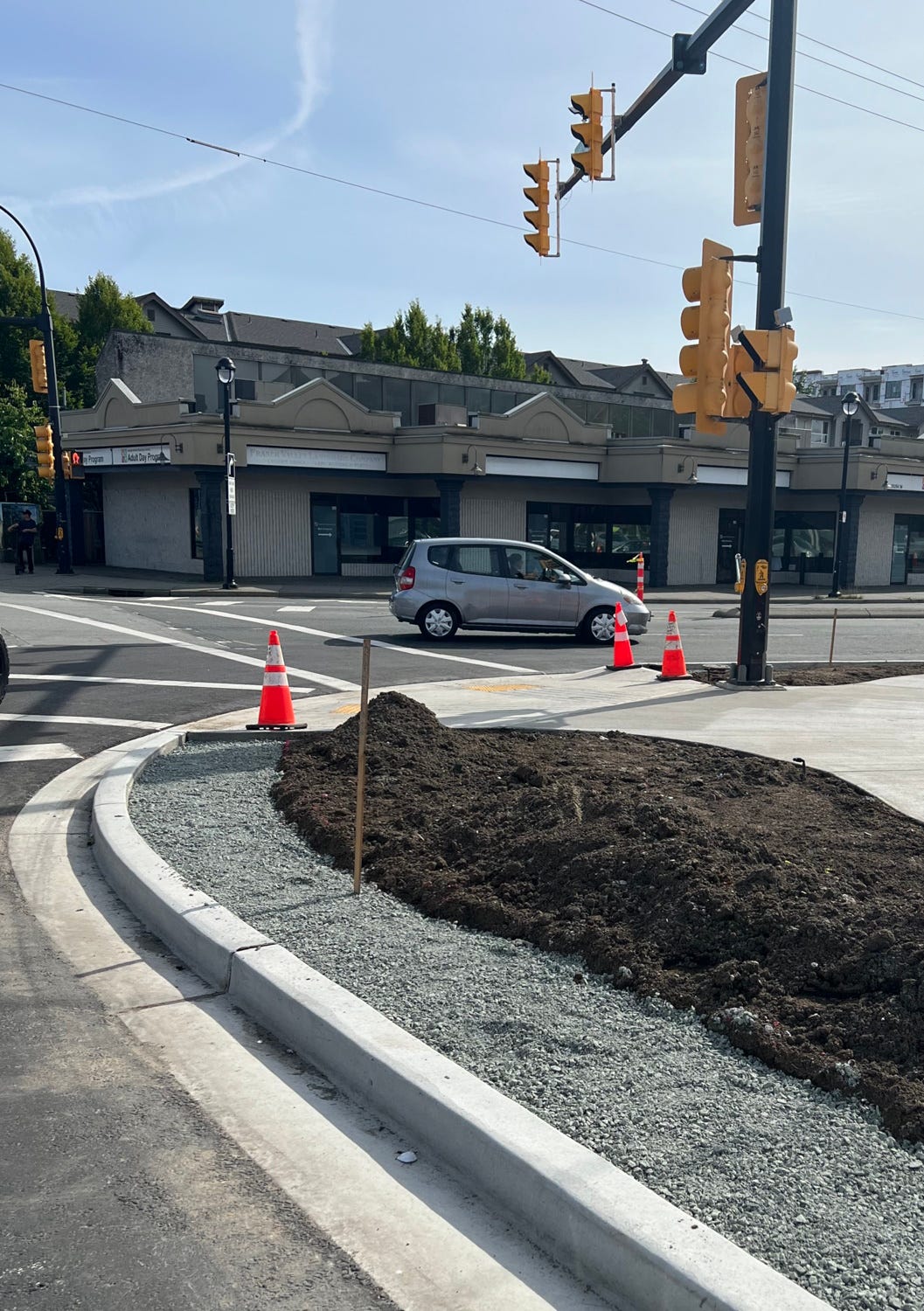
In July this year, the Langley City council announced the Fraser Highway Oneway Renewal Project.
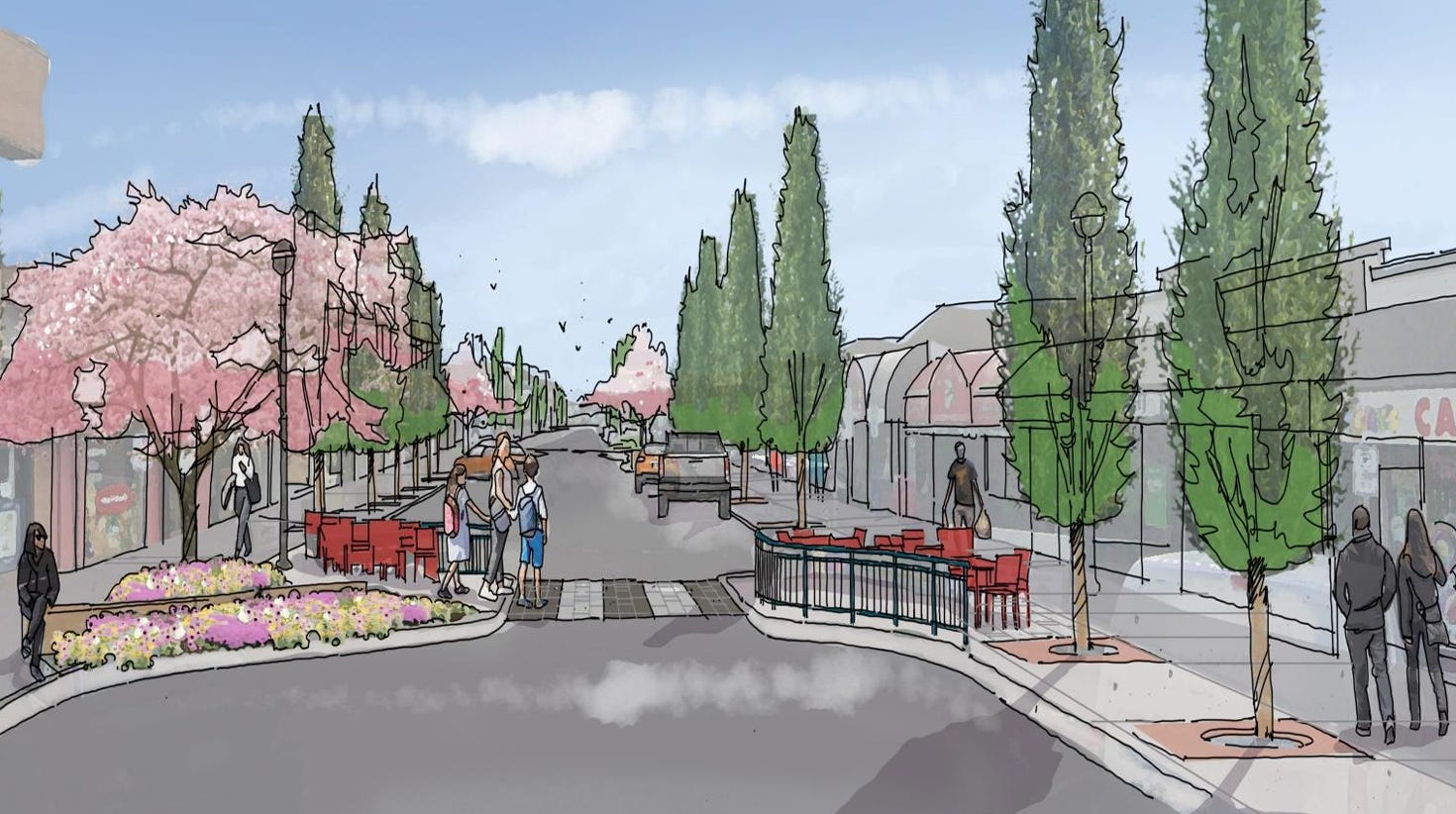
While it is disappointing to see cars still permitted to access what I would describe as a “high street” perfect for complete pedestrianization, it will bring wider sidewalks to the one way, something more akin to the pseudo-pedestrianized Government Street in Victoria.
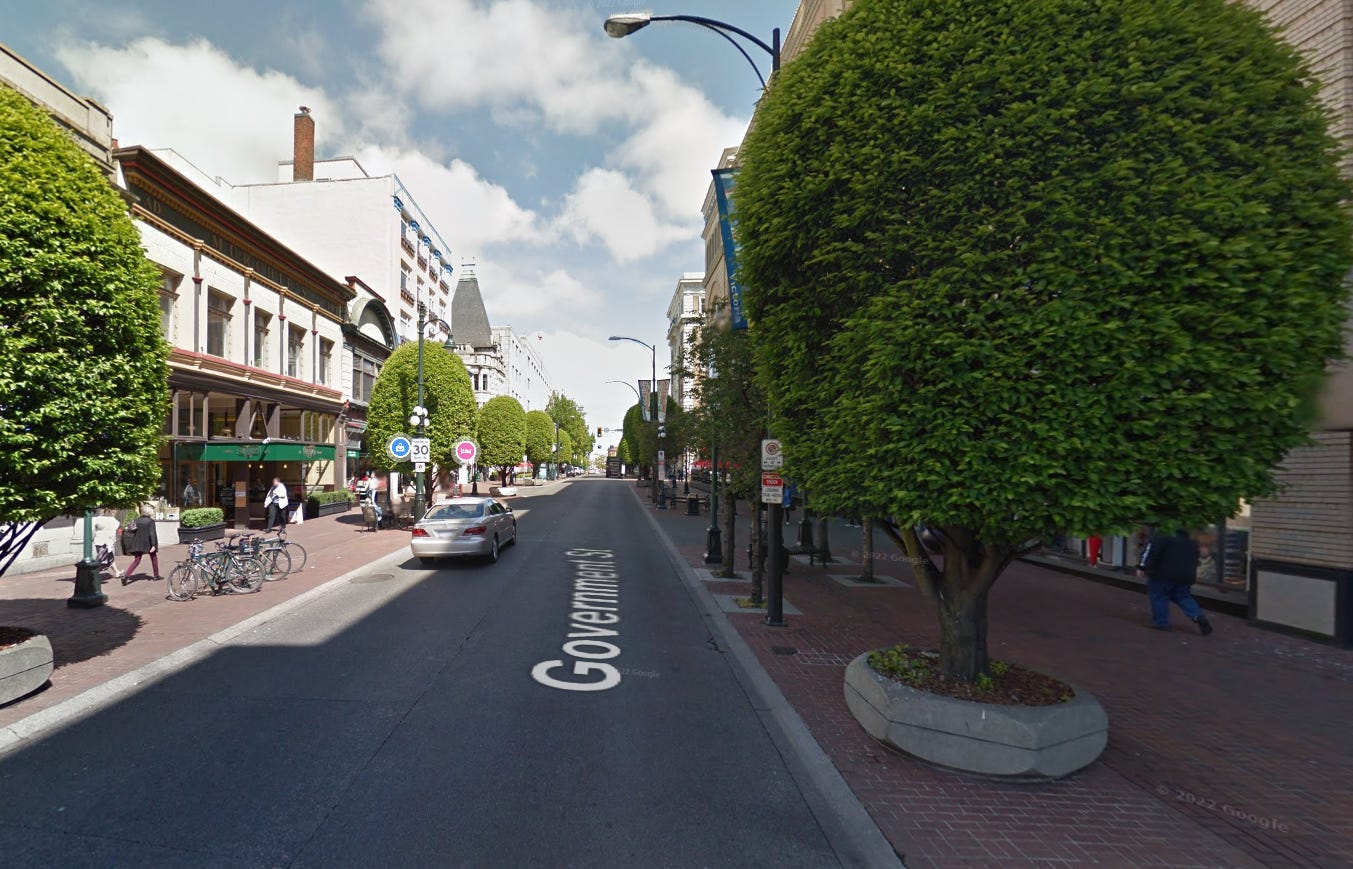
As such, I award Langley City a B for this years progress - great, but still some way to go and some missed opportunities. It is worth noting that in previous years Langley City has already taken significant steps towards safer streets. 203rd Street has a separated Multi-Use Path for example, and many routes have dedicated bus lanes.
End Parking Mandates and Subsidies
Langley Township
Since 1995, Fort Langley has had a special “off-street parking bylaw” that allowed business owners to pay cash in lieu of meeting minimum parking requirements. This was because most buildings in Fort Langley are out of compliance with such legislation to begin with - for example the Planet Java 50s Diner, most of the lot is used by the building, so there is absolutely no way it could also have the number of parking spots required for it’s size
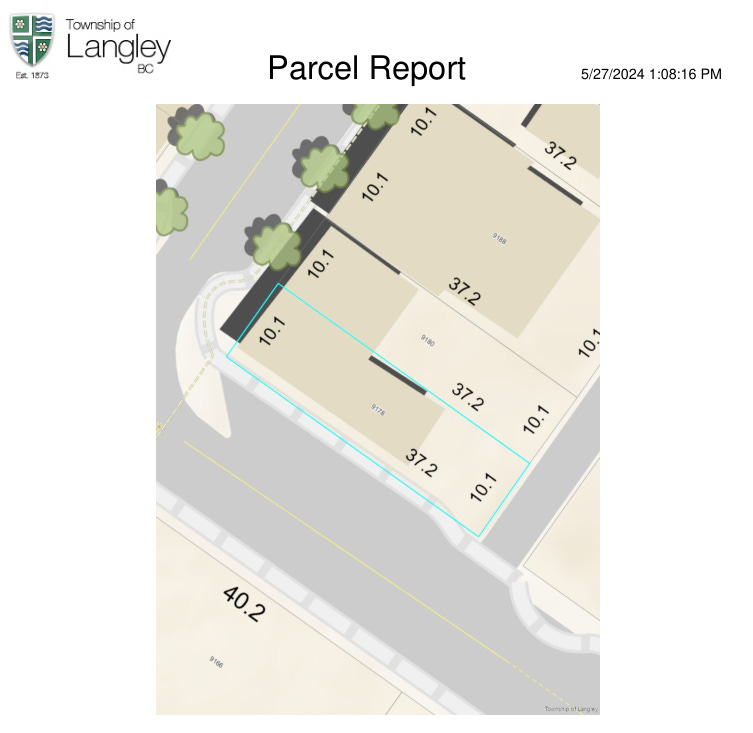
Of course, this is because these livable, walkable places don’t exist with parking minimums, but for the longest time, Fort Langley alone was granted this special exemption.
However, this year, Langley Township council approved extending this cash-in-lieu exemption to Aldergrove, which has a similar traditional built form to Fort Langley.
While this is good news for those in Aldergrove, who no longer have to worry about getting their building into parking-minimum compliance when doing a major renovation, it does beg the question - why have we limited this to just those areas?
Should Yorkson - which was supposed to be designed like a traditional town - have parking minimums? Why should anywhere in the Township of Langley have it?
Parking minimums are fundamentally harmful to community development and economic vitality. They force developers to waste valuable land on parking spaces that could otherwise be used for housing, businesses, or public spaces. This artificial inflation of parking supply drives up construction costs, which get passed on to residents and business owners through higher rents and prices. The excess parking also encourages more driving by making it artificially convenient, leading to increased traffic congestion and emissions, while making communities less walkable and transit-friendly.
Removing these mandates allows the market to determine the right amount of parking based on actual demand, resulting in more affordable development and more vibrant, sustainable neighbourhoods.
As such I give the Township of Langley a C - the Aldergrove bylaw is a step in the right direction, but ultimately still not enough to solve this underlying issue.
Langley City
Unfortunately, no progress has been made for Langley City when it comes to addressing Parking Minimums, aside from implementing the provincially mandated no parking minimums for Transit Oriented Areas and Multiplexes near frequent transit stops. Given as Langley City has a number of more traditional-style urban areas, similar to Fort Langley and Aldergrove, it would be nice to see Langley City take some leadership here and eliminate parking minimums, especially with the forthcoming arrival of Skytrain. So unfortunately I have to give Langley City a D grade here.
Incremental Housing
Langley Township
Unlike other municipalities, the Township of Langley does not permit laneway homes or garden suites. They also do not even allow Single Family Homes in older R1 zones with basements to have two suites, they just allow two kitchens, which has the same effect but is a strange distinction.
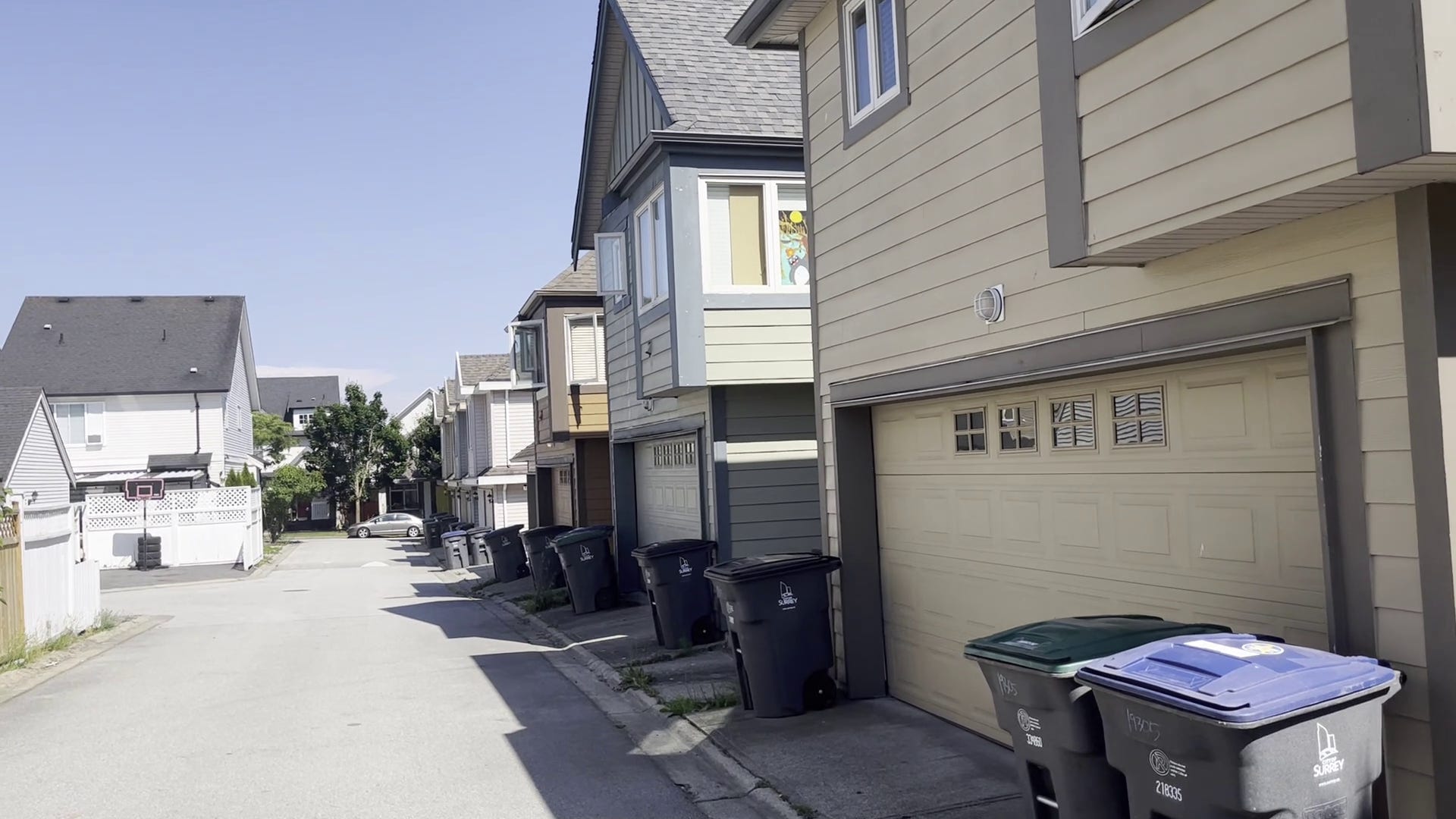
In East Clayton in Surrey, there are many houses that back onto a laneway with coach house above the garage. In most of the Township of Langley this is not permitted except for some select parts of Murrayville and Willoughby.
When the province stepped in to override these rules with Bill 44 - which allows for multiplexes of 4 units in all existing single family areas - the current Langley Township council have been very vocally opposed to it, with articles in the news and constant deferrals on it’s implementation.
The justification given in a recent interview with the mayor seemed to boil down to that it was unnecessary to retrofit existing areas as Langley has approximately 2500 acres of land and that Langley is delivering townhomes and apartments without the need to touch existing neighbourhoods.
As we observed in Willoughby, building on greenfield land required an effective developer subsidy for 10 years to “jump start” it, something that has proven to be very costly, and it remains to be seen just how long this surge of investment from the development industry will continue, particularly as immigration levels are set to drop to near zero in the next two years and borrowing rates remain high despite the central bank lowering rates.
Additionally, other neighbourhood plans outside of Willoughby like Brookswood are not showing positive signs so far. Developers are gravitating to the low-risk low-density areas of the plan first, building single family homes, as they typically do without an incentive or subsidy in place to get things started.
When community members are able to expand their homes with laneway houses, garden suites, or simply converting their existing home into a duplex or triplex, this often takes the form of bottom-up community led improvement that can run countercyclical to larger market cycles of the development industry. To me there is no meaningful justification to restrict people so heavily on what they can do with their property in terms of subdivision and expansion in this capacity.
Even adding any extension to your house requires structural and drainage engineers. We could instead allow extensions of a certain type/size to get more easy approval.
There are some small signs things may be changing - a new development has been proposed in Walnut Grove that is set to rezone an underused large commercial site into townhomes. We need more clear pathways for this kind of better use of large suburban lots in established areas.
Despite this, overall Langley Township gets an E from me, not a complete failure, but we continue to limit growth in older neighbourhoods that could be welcoming many new residents with some thoughtful and exciting zoning reforms.
Langley City
Langley City however has been making exceptionally great strides to implement incremental development. While it is still largely developer led, they have been able to start to densify single family areas. It is not unusual to see a mid-rise block of apartments next door to a single family home.
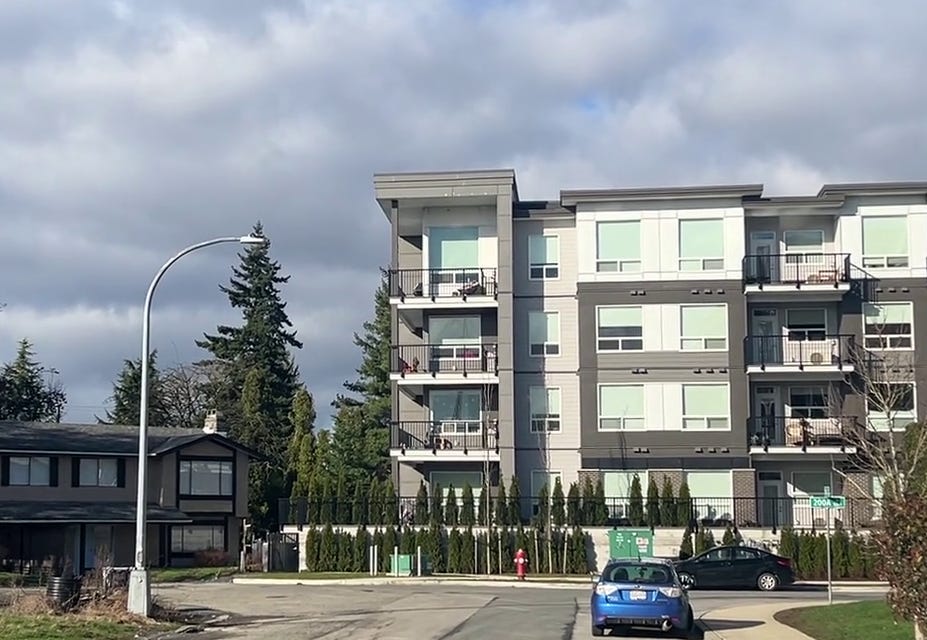
This is of course how all cities developed naturally in the past - as places became hubs of economic activity, the land use becomes intensified as more investment and people flood into the area. It is only under the suburban planning and zoning regime that “intensification” is suppressed with the use of zoning bylaws that limit density and ultimately cause economic stagnation and rising real estate prices.
Langley City does still have a zoning code, but has clearly been more willing to open up pockets of density in areas that would previously would be seen as politically “untouchable”, such as single family neighbourhoods.
Recently a parking lot infill project was proposed in the form of a new development opposite city hall, which makes much better use of existing land in the community currently wasted on parking lots.
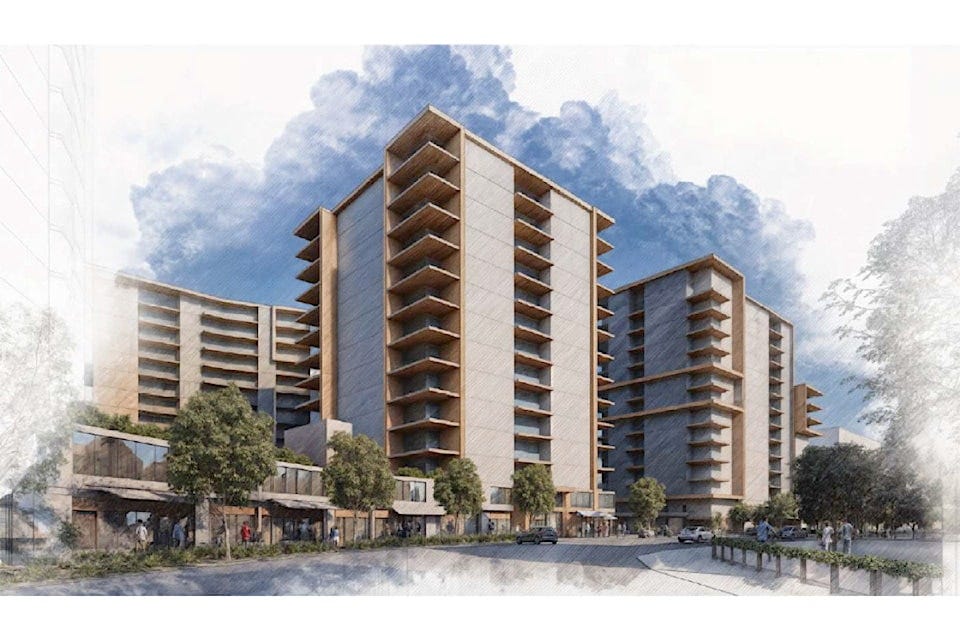
Additionally, all of the provincial housing legislation was quickly adopted without incident.
Langley City gets an A+ in this department. In a sense they are pushed this direction by their small size to implement these positive changes, but it is still very encouraging to see this kind of progress.
Transparent Local Accounting
Both Langley Township and Langley City really just do the bare minimum when it comes to providing local accounting and really just do enough to meet the legislative requirements. In the past couple of years, Langley Township has significantly increased the size of it’s Community Amenity Contribution (CAC) fund by dramatically increasing the fees paid by developers. While Langley City does not require developers pay CACs, it has it’s own external funding source in the form of taxes collected from the Cascades Casino.
The biggest difference between the two municipalities is the new debt-based model now being employed by Langley Township, introduced in order to keep property taxes low while providing desperately long-time needed civic amenities to new areas like Willoughby. Previous councils were more interested in juicing growth in Langley, rather than collecting enough fees to pay for all the needed upgrades in a timely fashion, so this new approach seems to be to take on debt with this eventually being repaid with future development.
In some areas this plan seems to be working. For the 208 St widening they used “DCC-funded debt” to basically get the road widened first with the hopes of recouping the funds later. The total road DCC-funded debt was around $19 million. A recent development application was discussed at a public hearing located along this new widened section of 208 St, the DCC road amount paid will be around $10 million. So just one development along the route has covered a significant portion of the cost.
Of course this is me just looking and figuring out the numbers by myself, which while technically it is available, there is very little public transparency about this plan and how it all plans to play out and it requires quite a bit of digging to start to calculate.
It’s also worth noting that the more of this debt-based model grows, the more riskier it becomes. The risk/reward balance may start out as acceptable for one or two things, but to finance all public works projects in a way that depends on continuous growth is quite high risk.
As I have stated before, Langley Township needs to go back to why Willoughby was built so rapidly and with a developer subsidy in the first place. From what we can tell, it was most likely due to underperforming low-density suburban areas. Instead of a debt-based only approach, the Township needs to help make older neighbourhoods more financially sustainable with more densification, so we can break out of this cycle.
Neither the CAC fund or the Casino fund are really allocated in a consistent or clear manner. As part of its housing reforms, the provincial government introduced Amenity Cost Contributions, or ACCs, as an alternative. The difference is it makes this accounting more transparent as each amenity has to be designated and given it’s own fund. You might specify an ACC “account” for local library for example. It would be nice to see both municipalities adopt this framework.
Both municipalities could go further in analyzing and reporting the long-term costs of infrastructure over its full lifecycle. There's also limited discussion of the accumulated maintenance backlog for existing infrastructure or strategies to address it beyond acknowledging the funding gap. Both could provide more detailed neighborhood-level financial analysis, creating accessible visualizations of infrastructure liabilities, and developing clear metrics for measuring the fiscal sustainability of different development patterns.
As such, both municipalities have some way to go here, C.
Ending Highway Expansion
Langley Township
In a strange sort of contradiction from Langley Township’s commitments to Safer streets in the form of road diets and traffic calming in Walnut Grove, there has been a continual push for road widening, in both the new Brookswood Plan, which calls for a network of 4 lane arterials throughout, and in Willoughby, where plans are being pushed forward to widen 80 Avenue, 202 Street and a section of 86 Avenue between 200 Street and Carvolth Exchange.
While these streets were always designated as “arterial” in the Willoughby Neighbourhood Plan, this plan was from 2001, and it is worth a second look now that the neighbourhood has developed to see whether this is is still the right approach and a good idea.
This section of 202 St which was completed last year shows how large roads really harm the character of an area, with a wide impassable road directly outside people’s front doors.
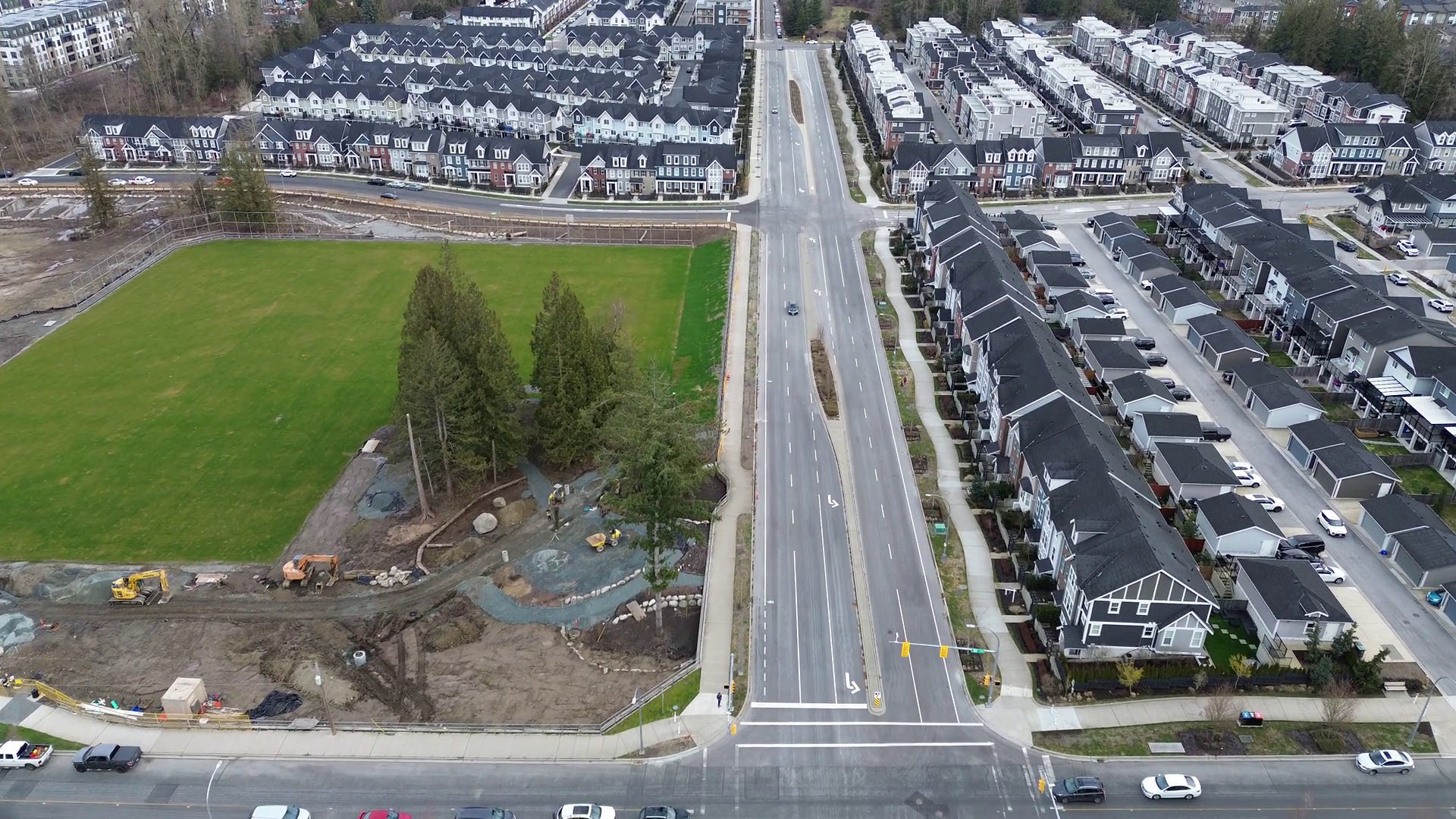
This could be a street where the kids who live in these houses could run out and play on, instead we see continual sacrifice of our public spaces to accommodating high-speed vehicle traffic instead, killing the vitality and livability of these places.
Now there’s nothing wrong with a select number high speed connecting roads per-se, to help people get around town, the problem is how, in Willoughby, and now potentially in Brookswood as well, they are placed right in the middle of new developments, where they carve up and divide communities and deny residents the potential of joyful street life.
There’s also the matter of the ongoing costs of maintaining such infrastructure. While development fees might cover the initial construction cost, it won’t cover the ongoing maintenance, and to keep property taxes low we can become dependent on ongoing expansion to try and bring in more development fees which go to cover maintenance costs of the previous generation of growth, which is an unsustainable cycle.
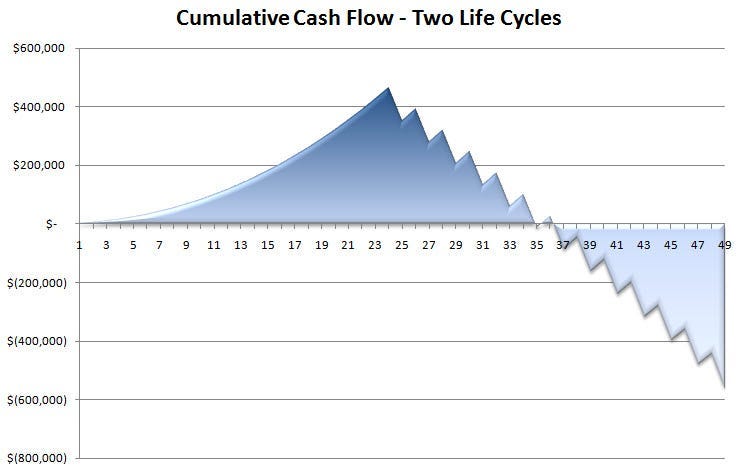
Each new road built is a long-term liability, and the wider it is, the more expensive it is to maintain, so we should be trying to moderate road width and overall new road construction to keep our long term costs down.
The only positive is that many of the new road widening projects will feature protected cycling infrastructure, so do bring the benefit of expanding the safe cycling network.
However, until we see a serious commitment to having a select number of high-speed roads on the outskirts of neighbourhoods, instead of many wide roads down the middle, Langley Township gets a D.
Langley City
Langley City has been on a continuous push to narrow its streets, rather than widen any of them. In 2020, it changed lanes on some of it’s oversized roads into bus lanes. In 2023 it narrowed Douglas Crescent outside City Hall with a cycling lane.
Of course, Langley City hasn’t seen the same level of growth as North Langley, which is undoubtedly a factor, however even with some of the infill development we talked about earlier, there hasn’t been an immediate push for road widening adjacent to it.
As of writing this article, not a single road widening project is planned. As such Langley City gets an A.
Conclusion
In reviewing Langley's performance across Strong Towns' five core campaigns in 2024, we see a tale of two municipalities with distinct approaches and varying levels of success. Langley Township has shown remarkable progress in street safety with innovative projects like concrete curb bump-outs and road diets, yet continues to struggle with parking reform, incremental housing, and its persistent focus on road expansion. Meanwhile, Langley City has emerged as a leader in several areas, particularly in embracing incremental development and moving away from car-centric street design, though it still has room for improvement in parking reform.
As we look ahead to 2025, the contrast between these neighbouring municipalities offers valuable lessons: Langley City's willingness to embrace density and human-scaled development demonstrates how smaller communities can lead the way in progressive urban planning, while Langley Township's mixed approach highlights the ongoing tension between maintaining suburban patterns and building a more sustainable, financially resilient future.
The successes we've seen this year - from traffic calming initiatives to innovative infill developments - prove that positive change is possible. And we applaud both councils for their positive effort. We want to focus more on these positive achievements, rather than the negative. However, the varying grades across these five critical areas suggest that both municipalities still have significant work ahead to truly become "strong towns." The key challenge for 2025 will be building on these successes while addressing the remaining barriers to creating more livable, financially sustainable communities.
Strong Towns Langley is a community group dedicated to making Langley, British Columbia a better place. We advocate for incremental development, sustainable transportation solutions, housing accessibility, public spaces, and responsible growth strategies. Our group is part of the larger Strong Towns movement, focusing on creating financially resilient and people-oriented communities.
To learn more visit https://strongtownslangley.org